
Why Your Tinnitus Is Worst at Night (And What Actually Helps)
A neurotologist explains why tinnitus often feels worse at night and shares evidence-based strategies that can make sleep easier.
By Yuan Liu, MD
Short answer: tinnitus often feels worse at night because quiet removes competing sound, attention narrows onto the signal, and insomnia-related hyperarousal makes the distress loop harder to shut off.
The 3 AM Club Nobody Wants to Join
It's 3:14 AM. You know this precisely because you've been staring at the clock for the past hour and forty-seven minutes. The house is silent except for that damned ringing—louder now than it was at dinner, louder than it was when you first lay down, impossibly loud in the darkness.
You've tried everything. White noise machine (made it worse). Earplugs (definitely made it worse). Meditation app (couldn't concentrate over the noise). Now you're googling "tinnitus worse at night" on your phone, the blue light adding insult to injury, finding this article among the thousands of others written by people who probably sleep just fine.
Except I don't always sleep just fine. And neither do many tinnitus patients who describe the night as their personal hell. After years as a neurotologist, I've heard this story often enough that I could recite it back: the dread as bedtime approaches, the phantom symphony that crescendos in darkness, the cruel irony that the very rest you need to cope with tinnitus becomes impossible because of it.
But here's what I've also learned: nighttime tinnitus isn't just "regular tinnitus in the dark." It's a distinct phenomenon with specific causes, predictable patterns, and—most importantly—evidence-based solutions that actually work.
The Science of Nighttime Amplification
To understand why your tinnitus seems to have a vendetta against your sleep, we need to examine what's happening in your brain after sunset. It's not your imagination—multiple physiological changes conspire to make tinnitus genuinely worse at night.
The Silence Problem
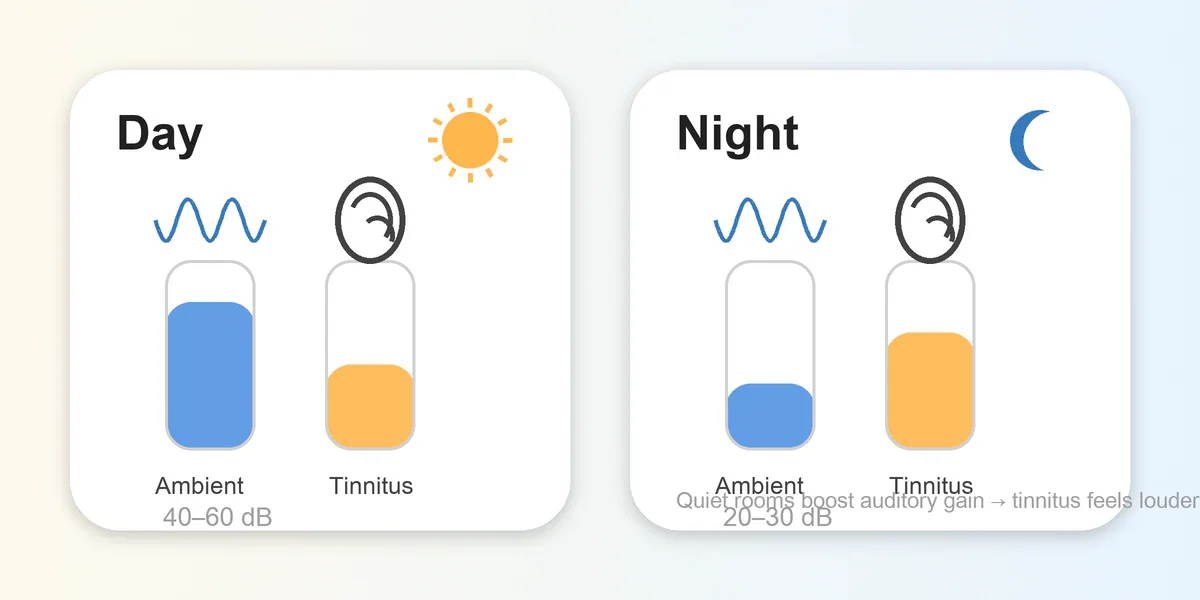
During the day, your auditory system is like a busy restaurant—constant ambient noise, conversations, traffic, the hum of life. Your tinnitus is still there, but it's one voice in a crowd. Environmental sounds typically measure 40-60 decibels during daytime activities.
At night? Your bedroom might drop to 20-30 decibels. In that relative silence, your tinnitus has no competition. It's like being the only person in that restaurant, your voice echoing off empty walls.
But it's not just about masking. Your brain has what we call "gain control"—like the automatic volume adjustment on your phone during calls. In quiet environments, your auditory system can become more sensitive, searching for input. Classic psychoacoustic work found that silence itself can make phantom sound perception more noticeable, and tinnitus reviews describe the same broader idea as central gain.
The Attention Spotlight
During the day, your brain is a master of divided attention. You're processing work tasks, navigating traffic, having conversations, and handling dozens of demands. Tinnitus might get only a small slice of your attention, if that.
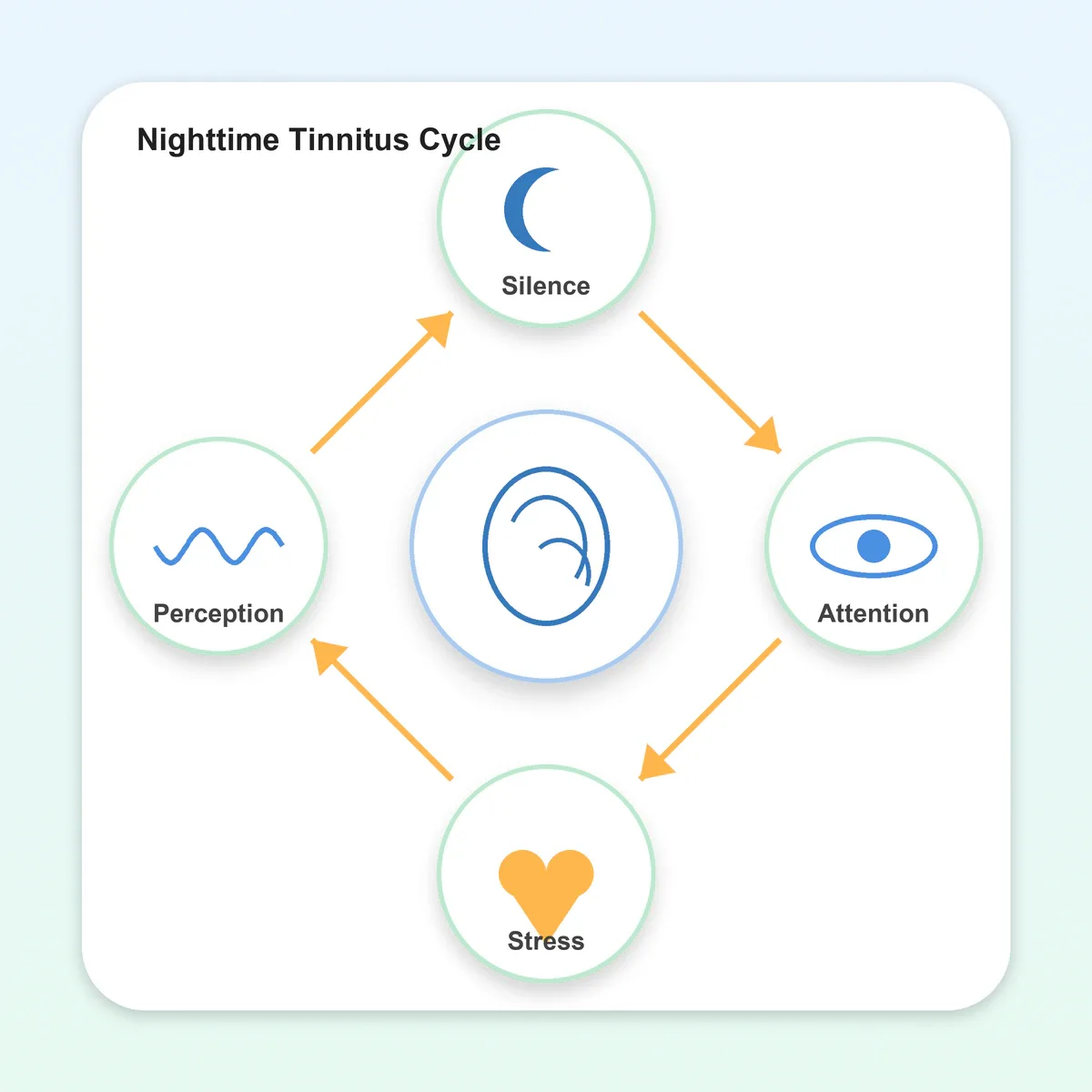
But lying in bed, in darkness, with nothing to do but sleep? Your brain becomes a spotlight with only one thing to illuminate: that sound. Neuroimaging work suggests quiet wakefulness can amplify self-focused attention and tinnitus salience. You're not just hearing your tinnitus; you're attending to it with much more of your conscious awareness.
This creates what psychologists call "selective attention enhancement." The more you focus on the tinnitus, the more neural resources your brain dedicates to processing it, which makes it seem even louder, which makes you focus on it more. It's a neurological Chinese finger trap.
The Stress Hormone Surge
Here's where things get particularly cruel. As bedtime approaches, many tinnitus sufferers experience what I call "anticipatory anxiety." You remember last night's struggle, and your stress response activates before your head even hits the pillow.
This triggers a cascade of stress hormones—cortisol, adrenaline, noradrenaline—that have direct effects on tinnitus:
- Cortisol increases neural excitability in the auditory cortex
- Adrenaline enhances sensory perception across the board
- Noradrenaline disrupts the brain's normal filtering mechanisms
Recent work on tinnitus-related insomnia points to hyperarousal, worry, and unhelpful sleep beliefs as major drivers of bad nights. Daily-life studies also show that negative emotional states track with worse tinnitus distress, which helps explain why a stressful evening can turn a manageable sound into a miserable night.
It's like your brain is simultaneously trying to sleep and run from a tiger. No wonder the tinnitus seems unbearable.
The Circadian Connection
Your tinnitus follows a schedule more religiously than you do. This isn't coincidence—it's connected to your circadian rhythm in ways we're only beginning to understand.
The Melatonin-Tinnitus Link
Melatonin, your body's sleep hormone, does more than make you drowsy. It also helps coordinate the transition into sleep. We do not have strong evidence that tinnitus always comes from a melatonin deficiency, but we do have clinical evidence that sleep-targeted treatment matters: in a randomized placebo-controlled crossover trial, melatonin improved sleep in patients with tinnitus, with the biggest gains in people who already had sleep difficulty.
The Temperature Factor
Your body temperature naturally drops 1-2 degrees Fahrenheit as you prepare for sleep. This temperature drop affects blood flow throughout your body, including the delicate vasculature of your inner ear.
For some patients, this reduced blood flow decreases oxygen delivery to already struggling hair cells, intensifying tinnitus. Others experience the opposite—blood vessel dilation as the body cools, creating pulsatile tinnitus that matches their heartbeat.
I had one patient, a 52-year-old engineer, who meticulously tracked his tinnitus against room temperature for three months. Below 68°F, his tinnitus consistently worsened. Above 72°F, he couldn't sleep from being too warm. His sweet spot? 69.5°F, which he maintains with obsessive precision. "It's like my ears have a thermostat," he told me. He's not wrong.
The Psychological Perfect Storm
Nighttime tinnitus isn't just a physical phenomenon—it's a psychological perfect storm that would challenge anyone's mental resilience.
The Catastrophization Cascade
Lying in darkness, your mind becomes a prediction machine focused on worst-case scenarios. Cognitive psychologists call this "catastrophic thinking," and it follows a predictable pattern:
10:30 PM: "I hope tonight is better." 11:00 PM: "It's pretty loud. This might be bad." 11:30 PM: "I'm never going to sleep." 12:00 AM: "I have that presentation tomorrow. I'll be exhausted." 12:30 AM: "I can't function like this." 1:00 AM: "My life is ruined."
Each thought increases stress, which increases tinnitus perception, which validates the catastrophic thinking. Your brain, trying to be helpful, is actually creating the reality it fears.
The Loneliness Factor
At 3 AM, tinnitus is profoundly isolating. Your partner sleeps peacefully beside you, oblivious to the cacophony in your head. The world is asleep while you wage a solitary battle against a sound only you can hear.
This isolation amplifies distress. Humans are social creatures; we're wired to seek comfort from others during distress. But who do you turn to at 3 AM? This forced solitude can trigger what psychologists call "existential anxiety"—fundamental fears about suffering, meaninglessness, and mortality that are usually kept at bay by daily distractions.
One patient described it perfectly: "During the day, I have tinnitus. At night, tinnitus has me."
Why Traditional Sleep Advice Fails
Well-meaning friends, doctors, and internet articles offer the same tired advice: "Practice good sleep hygiene." "Try chamomile tea." "Just relax."
This generic advice fails because nighttime tinnitus requires specific, targeted interventions that address both the auditory and psychological components. Let me explain why standard approaches fall short and what actually works.
Why "Just Relax" Is Impossible
Telling someone with screaming tinnitus to "just relax" is like telling someone being chased by a bear to "just calm down." Your brain perceives tinnitus as a threat signal—millions of years of evolution have programmed us to pay attention to unexpected sounds in darkness. They might be predators.
Your amygdala (fear center) doesn't care that you logically know tinnitus isn't dangerous. It responds to the signal itself, triggering fight-or-flight responses that make relaxation physiologically impossible without specific techniques to bypass this ancient wiring.
Why Complete Silence Backfires
Many sleep experts recommend complete silence for optimal sleep. For tinnitus sufferers, this is precisely wrong. Complete silence is your enemy—it's the canvas on which tinnitus paints its loudest masterpiece.
But here's the catch: the wrong sounds make things worse. White noise machines, so often recommended, can actually aggravate certain types of tinnitus. High-frequency white noise can clash with high-pitched tinnitus, creating an auditory discord that's worse than the original sound.
The Evidence-Based Nighttime Protocol
After reviewing the literature and years of clinical practice, I've developed a nighttime protocol that actually works. It's not magic. It's a systematic approach based on neuroscience and validated by research.
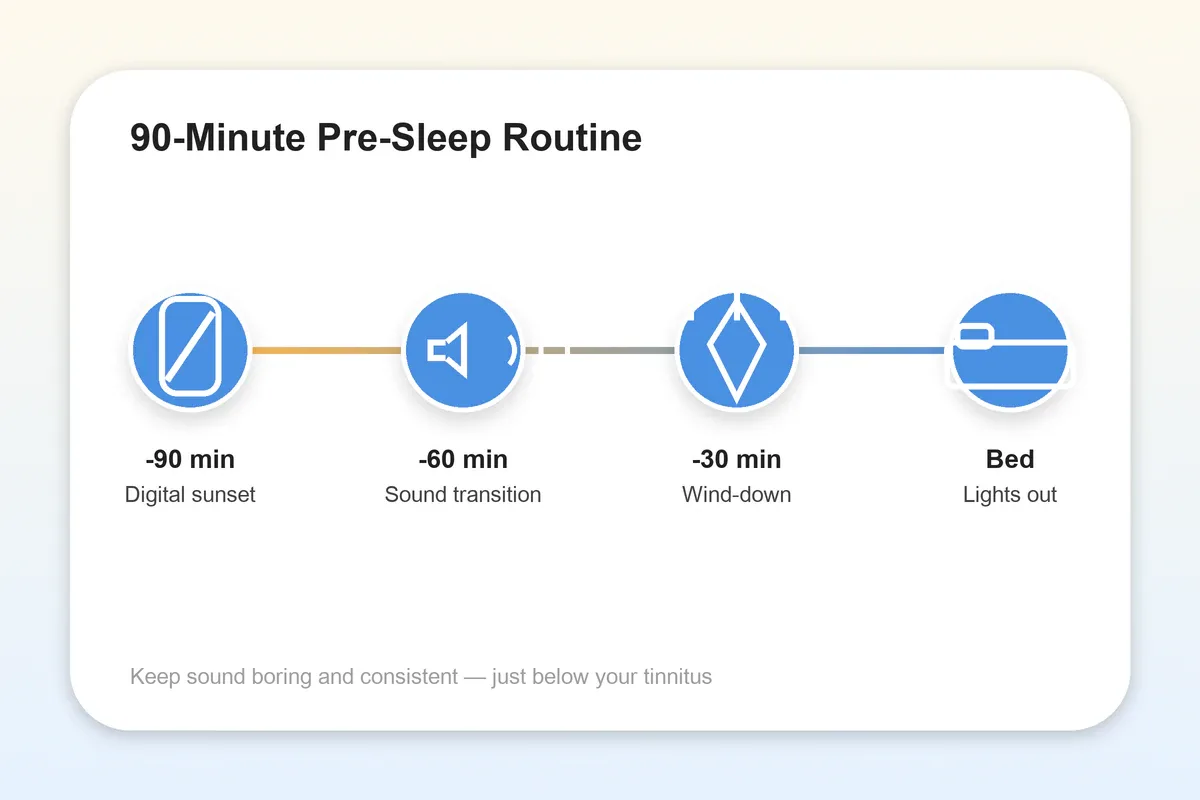
Phase 1: The Pre-Sleep Routine (90 Minutes Before Bed)
T-minus 90 minutes: The Digital Sunset
Screens off. I know you've heard this before, but for tinnitus sufferers, it's crucial. The strongest evidence here comes from sleep science rather than tinnitus-specific audiology: blue light delays melatonin release, and stimulating content keeps the brain alert. If tinnitus already has your attention, that is the last thing you want before bed.
Instead of screens:
- Amber-tinted glasses if you must use devices
- Physical books with warm lighting
- Gentle stretching or yoga
- Preparation for tomorrow (reduces anxiety)
T-minus 60 minutes: The Sound Transition
Begin transitioning your sound environment gradually. Don't go from TV to silence—that's like diving into ice water. Instead:
- Reduce TV/music volume by 50%
- Introduce background sound (more on which types below)
- Gradually shift from engaging content to neutral sounds
T-minus 30 minutes: The Biological Wind-Down
This is when you actively trigger your parasympathetic nervous system:
- Warm shower or bath: The subsequent temperature drop mimics natural circadian cooling
- 4-7-8 Breathing: Inhale for 4, hold for 7, exhale for 8. This activates vagus nerve
- Progressive muscle relaxation: Start with toes, work upward
- Magnesium glycinate: 200-400mg (if approved by your doctor)
Phase 2: The Sound Strategy
Not all sounds are created equal for nighttime tinnitus. After testing hundreds of options with patients, here's what works:
The Goldilocks Principle
Sound should be:
- Just below your tinnitus volume (not masking completely)
- Consistent (no sudden changes)
- Boring (yes, boring—engagement prevents sleep)
Sound Matching Guide
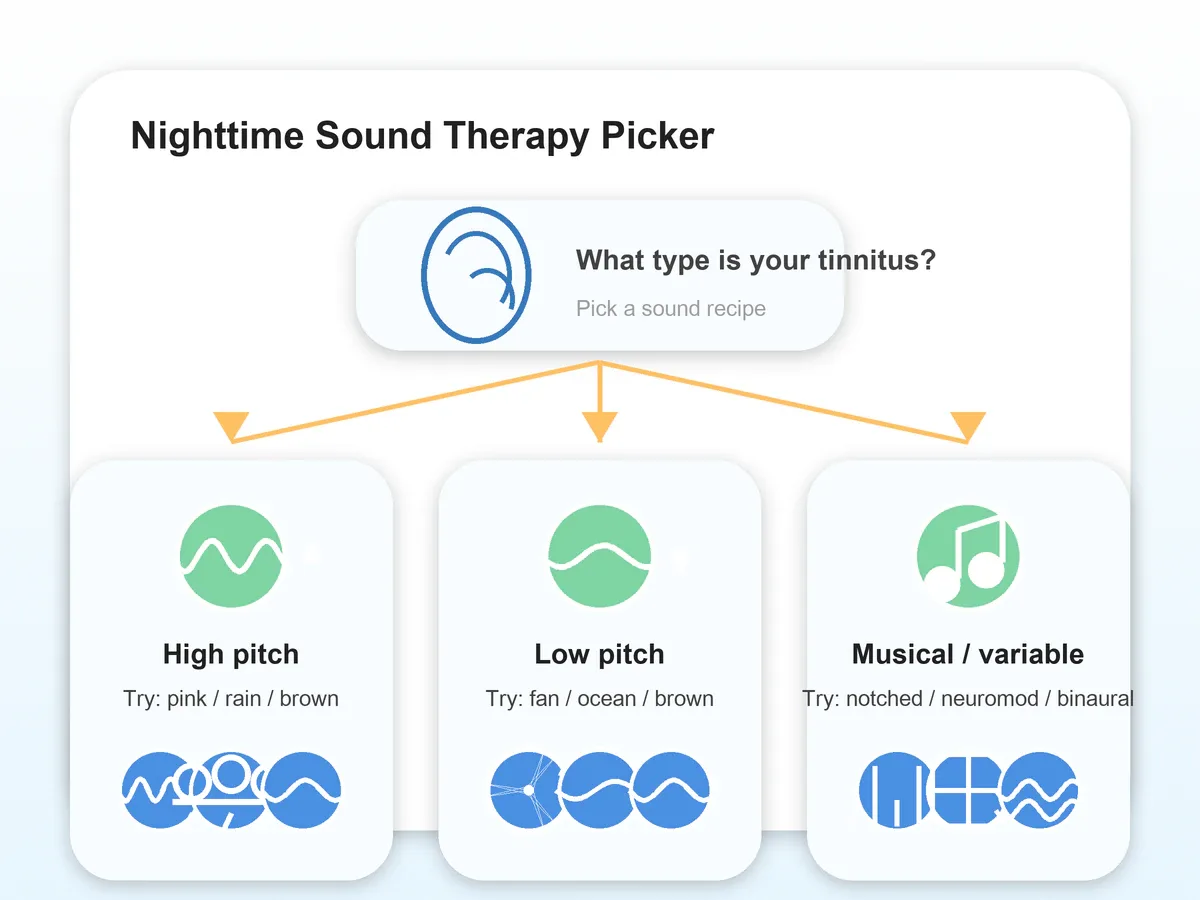
For high-pitched tinnitus (>3000 Hz):
- Pink noise (gentler than white)
- Rain sounds (without thunder)
- Brown noise
- Avoid: White noise, crickets, high-frequency nature sounds
For low-pitched tinnitus (<1000 Hz):
- Fan sounds
- Ocean waves (continuous, not crashing)
- Brown or violet noise
- Avoid: Bass-heavy sounds, thunder, machinery
For variable/musical tinnitus:
- Notched sound therapy (frequency-matched)
- Neuromodulation apps
- Binaural beats (alpha waves, 8-10 Hz)
- Avoid: Music, podcasts, anything with patterns
The Two-Speaker Setup
Here's a trick that's surprisingly effective: Use two sound sources at different volumes:
- Bedside speaker: Low-volume brown noise (constant baseline)
- Across room: Slightly louder nature sounds (variety without startling)
This creates a three-dimensional sound environment that prevents your brain from fixating on any single sound—including your tinnitus.
Phase 3: The Cognitive Intervention
When you're lying there and the tinnitus seems overwhelming, these specific techniques can break the spiral:
The 5-4-3-2-1 Grounding Technique
Identify:
- 5 things you can see (even in darkness—clock, window outline)
- 4 things you can touch (sheets, pillow, mattress, blanket)
- 3 things you can hear besides tinnitus (house settling, partner breathing, distant traffic)
- 2 things you can smell (laundry detergent, partner's shampoo)
- 1 thing you can taste (toothpaste residue)
This forces your brain to process multiple sensory inputs, diluting tinnitus attention.
The Paradoxical Approach
Instead of trying NOT to hear your tinnitus (which is impossible), try to hear it MORE clearly. I know this sounds insane, but stay with me:
- Focus intently on your tinnitus for 30 seconds
- Try to identify its exact pitch
- Notice if it fluctuates
- Rate its loudness from 1-10
Paradoxically, this deliberate attention often reduces distress. You're taking control rather than being victimized. Acceptance-based tinnitus therapies are built on the same principle: dropping the fight with the sound often works better than trying to suppress it. In randomized work, acceptance and commitment therapy reduced tinnitus impact and performed at least as well as tinnitus retraining therapy.
The Story Technique
Create a boring, detailed story you tell yourself each night. Not an exciting adventure—something mundane:
"I'm walking through a grocery store. I enter through automatic doors. The floor is beige tile. I get a cart from the right side. The wheels squeak slightly. I walk to produce. I see apples—red ones, green ones. I pick up one apple. It's smooth. I put it in a bag..."
The detail forces cognitive engagement while the mundane content prevents arousal. Many patients never make it past produce.
A Reset Routine for Difficult Nights
Some nights, despite your best efforts, the tinnitus still feels overpowering. On those nights, use a simple reset routine instead of staying in bed frustrated:
The Reset Ritual
Step 1: Get Up (Critical) Don't lie there suffering. After 20 minutes of wakefulness, get up. Staying in bed creates a conditioned association between bed and tinnitus distress.
Step 2: Change Your Temperature
- Splash cold water on your face and wrists
- Step outside briefly if safe (temperature change + natural sounds)
- Or stand in front of an open freezer for 30 seconds
The temperature shock interrupts the stress cycle and resets your nervous system.
Step 3: The Boring Task Do something monumentally boring in dim light:
- Fold laundry
- Sort papers
- Read appliance manuals
- Do a jigsaw puzzle (seriously)
Avoid: Phones, TV, anything stimulating or stress-inducing
Step 4: The Return Only return to bed when genuinely sleepy (eyelids heavy, yawning), not just tired. There's a difference.
When To Consider CBT-I Support
When tinnitus has disrupted sleep for weeks, structured insomnia treatment may help. One option clinicians use is sleep restriction as part of CBT-I:
- Calculate your actual sleep time (not time in bed)
- Limit bed time to just that (minimum 5 hours)
- Keep consistent wake time (no matter what)
- Build sleep pressure (no naps)
- Gradually increase (15 minutes per week as sleep improves)
Example: If you're in bed 8 hours but sleeping 5, a clinician may temporarily narrow your sleep window to rebuild sleep drive and break the tinnitus-insomnia association. In a randomized clinical trial of CBT for tinnitus-related insomnia, CBT-I produced larger improvements in insomnia severity and wake time than standard tinnitus care, and more than 80% of the CBT-I group achieved a clinically meaningful reduction in insomnia symptoms.
The Morning After: Breaking the Cycle
How you handle the morning after a bad night determines whether you're building resilience or deepening the problem.
What Not to Do
- Don't catastrophize: "I'm exhausted" becomes self-fulfilling
- Don't cancel everything: Maintains normal circadian rhythm
- Don't nap longer than 20 minutes: Reduces tonight's sleep pressure
- Don't increase caffeine: Worsens tonight's tinnitus
The Recovery Protocol
Morning light exposure: 10,000 lux for 30 minutes or natural sunlight
- Resets circadian rhythm
- Suppresses melatonin
- Increases alertness without stimulants
Moderate exercise: 20-minute walk minimum
- Increases endorphins
- Reduces stress hormones
- Builds appropriate fatigue for tonight
Cognitive reframing: Instead of "I barely slept," try "I got some rest and I'm managing"
- Sounds silly but affects performance
- Self-compassion improves coping
Why We Built Reductinn: A Structured Nighttime Support Plan
Nighttime tinnitus is one of the moments when generic advice breaks down. Reductinn was built to make a repeatable tinnitus-CBT routine easier to access when the sound feels loud, sleep is fragile, and you need more than "just relax."
What Makes Reductinn Different
Structured CBT, not random tips
The app is organized around a 6-week CBT course, guided exercises, background sounds, and progress tracking. That matters because nighttime relief usually comes from repeating a small set of skills consistently, not from hunting for a new trick every night.
Tools you can revisit at night
The app currently includes:
- CBT lessons and guided exercises you can replay when tinnitus feels intrusive
- Relaxation-focused audio and practical reframing prompts to support your wind-down routine
- A library of background sounds such as white, brown, pink, and nature audio
- THI-based progress tracking so you can monitor whether your overall tinnitus burden is changing over time
What the app is designed to help with
The goal is not a guaranteed silent night. The goal is to help you:
- settle faster after a spike
- stop improvising at 2 AM
- build a repeatable wind-down routine
- notice whether your overall distress is trending in the right direction
The Partner Problem (And Solution)
Your tinnitus affects your partner too. They lose sleep from your restlessness, feel helpless watching you suffer, and may feel guilty that they can sleep while you can't.
For Partners: How to Help
Do:
- Ask what sound levels work for them
- Be patient with middle-of-night movement
- Understand this is a real medical condition
- Maintain normal bedtime routines (provides stability)
Don't:
- Say "just ignore it"
- Get frustrated with sound machines
- Take restlessness personally
- Suggest miracle cures from Facebook
The Two-Bedroom Solution
Let's be honest about something rarely discussed: separate bedrooms. For some couples, it's the best solution. This isn't about relationship problems—it's about medical necessity.
If you're considering this:
- Frame it as temporary or flexible
- Maintain intimacy in other ways
- Communicate openly about feelings
- Remember: Good sleep makes you a better partner
The Long Game: Your Journey with Reductinn
Nighttime tinnitus isn't typically solved overnight (forgive the pun). But with the right guidance, the journey can become more predictable and manageable. Here's a practical pattern many people aim for:
Week 1-2: Foundation (Free Trial Period)
- Learn your first CBT-i techniques
- Establish baseline sleep metrics
- Experiment with background sounds or masking options that feel calming
- Start breaking the anxiety cycle This is why we made the first few days free—you'll see real changes before paying anything
Month 1: Stabilization
- Master the core CBT exercises
- Build a more consistent wind-down routine
- Track whether your tinnitus burden and sleep difficulty are changing
- Notice first "good nights"
Month 2: Breakthrough
- Cognitive restructuring becomes automatic
- Better sense of which sounds and routines help
- Confidence handling setbacks grows
- More good nights than bad
Month 3: Transformation
- Personal night protocol feels more repeatable
- Bad nights no longer create panic
- Tinnitus present but no longer controlling
- Sleep confidence restored
The app supports that process with lessons, audio exercises, background sounds, and progress tracking in one place.
Three Common Nighttime Patterns
Different people get stuck in different loops at night. These are common patterns, not promises:
- Silence makes the tinnitus feel louder: Background sounds plus a steady wind-down routine may help
- Middle-of-the-night waking turns into panic: Cognitive reframing, breathing, and reducing clock-checking become the priority
- Stress and insomnia amplify each other: Broader anxiety or insomnia treatment may matter just as much as tinnitus-specific strategies
Your Personal Night Protocol
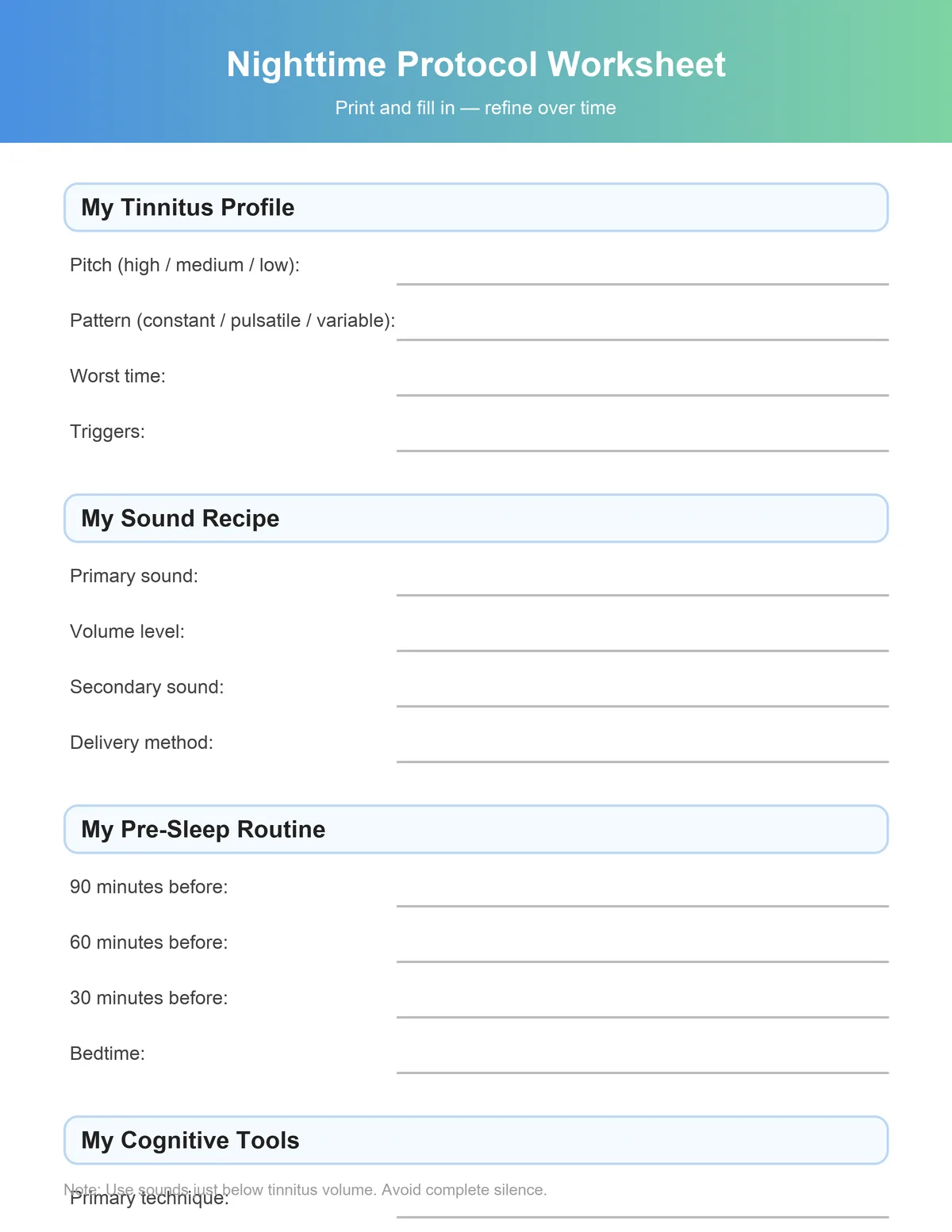
Based on everything we've covered, here's a template for your personalized nighttime protocol. Fill this out and refine over time:
My Tinnitus Profile:
- Pitch: _________ (high/medium/low)
- Pattern: _________ (constant/pulsatile/variable)
- Worst time: _________
- Triggers: _________
My Sound Recipe:
- Primary sound: _________
- Volume level: _________
- Secondary sound: _________
- Delivery method: _________
My Pre-Sleep Routine:
- 90 minutes before: _________
- 60 minutes before: _________
- 30 minutes before: _________
- Bedtime: _________
My Cognitive Tools:
- Primary technique: _________
- Backup technique: _________
- Emergency protocol: _________
My Sleep Environment:
- Temperature: _________
- Lighting: _________
- Bedding: _________
- Partner considerations: _________
Your First Night Can Be Different
As I write this at my desk, it's actually 2:47 AM. My own tinnitus—yes, many of us in this field have it—hums along at its usual frequency. The difference now? I have tools. Specific, evidence-based techniques that work. The same ones I've built into Reductinn.
You don't have to figure this out alone. You don't need to waste months trying random fixes. There are structured, research-backed ways to improve your nights, and digital tools can make those techniques easier to practice consistently.
Tonight could be different. Not perfect—I'm not selling miracles. But different. Better.
Imagine having:
- A clear set of cognitive techniques for nighttime spirals
- Background sounds ready when silence feels too intense
- A structured program that helps you practice consistently
- A way to track whether your tinnitus distress is changing over time
Start Your Journey Tonight (It's Free)
You've read this far because you're suffering. I get it. That's exactly why we made Reductinn free to try. No credit card. No tricks. Just download it, try the techniques tonight, and see for yourself.
Here's what you'll get immediately:
- Your first lessons from the Reductinn program
- Guided exercises for stress, attention, and tinnitus distress
- Background sounds you can use at night
- THI-based progress tracking inside the app
I know this much: the hardest part usually isn't learning the techniques. It's taking the first step. Make tonight the night you stop suffering alone and start your journey to better sleep.
The ringing might persist, but your nights don't have to be ruled by it anymore.
References and Resources
Key Scientific Studies
Tucker, D.A., Phillips, S.L., Ruth, R.A., Clayton, W.A., & Royster, E. (2005). "The effect of silence on tinnitus perception." Otolaryngology-Head and Neck Surgery, 132(1), 20-24.
Barry, J.G., Dibb, B., & Keogh, E. (2023). "Cognitive-behavioural factors in tinnitus-related insomnia." Journal of Sleep Research.
Probst, T., Pryss, R., Langguth, B., & Schlee, W. (2016). "Emotional states as mediators between tinnitus loudness and tinnitus distress in daily life." Journal of Affective Disorders, 208, 289-297.
Rosenberg, S.I., Silverstein, H., Rowan, P.T., & Olds, M.J. (1998). "Effect of melatonin on tinnitus." The Laryngoscope, 108(3), 305-310.
Marks, E., Hallsworth, C., Vogt, F., Klein, H., & McKenna, L. (2023). "Cognitive behavioural therapy for insomnia (CBTi) as a treatment for tinnitus-related insomnia: a randomised controlled trial." Cognitive Behaviour Therapy, 52(2), 91-109.
Westin, V.Z., Schulin, M., Hesser, H., Karlsson, M., Noe, R.Z., Olofsson, U., Andersson, G., & Hayes, S.C. (2011). "Acceptance and commitment therapy versus tinnitus retraining therapy in the treatment of tinnitus: a randomised controlled trial." Behaviour Research and Therapy, 49(11), 737-747.
Sleep Resources
- American Academy of Sleep Medicine: https://sleepeducation.org
- CBT-i Coach App: Free from VA, available to all
- Tinnitus Talk Support Forum: https://www.tinnitustalk.com/forums/support.4/
Recommended Sound Apps
- myNoise: Customizable soundscapes, excellent for tinnitus
- Noisli: Simple, effective background sounds
- Brain.fm: Science-based audio for sleep
- Naturespace: High-quality nature recordings
Dr. Yuan Liu is a board-certified neurotologist practicing at Torrance Memorial Physician Network in Torrance, California. He specializes in tinnitus and sleep disorders related to auditory conditions. This article is for educational purposes and should not replace professional medical advice.
Ready to Reclaim Your Nights?
Download Reductinn free and try these evidence-based CBT-i techniques tonight:
Download for iPhone (App Store)
Download for Android (Google Play)
Free to try • No credit card required • See results in days, not months
💡 Pro tip: Download it now while you're thinking about it. Even if it's daytime, you can start with the foundation exercises that make tonight's sleep easier.
Reductinn was developed by tinnitus specialists to deliver clinical-grade CBT-i techniques directly to your phone. If nighttime tinnitus is your worst window, the goal is simple: give you a plan that is still usable when you're exhausted.
Ready to take control?
Reductinn teaches these evidence-based techniques and more through a structured program designed by medical experts.