Does CBT Help Tinnitus? Evidence from 28 Randomized Trials
Does CBT help tinnitus? What 28 trials show about distress, quality of life and the limits of treatment, with links to the Cochrane review.
By Yuan Liu, MD
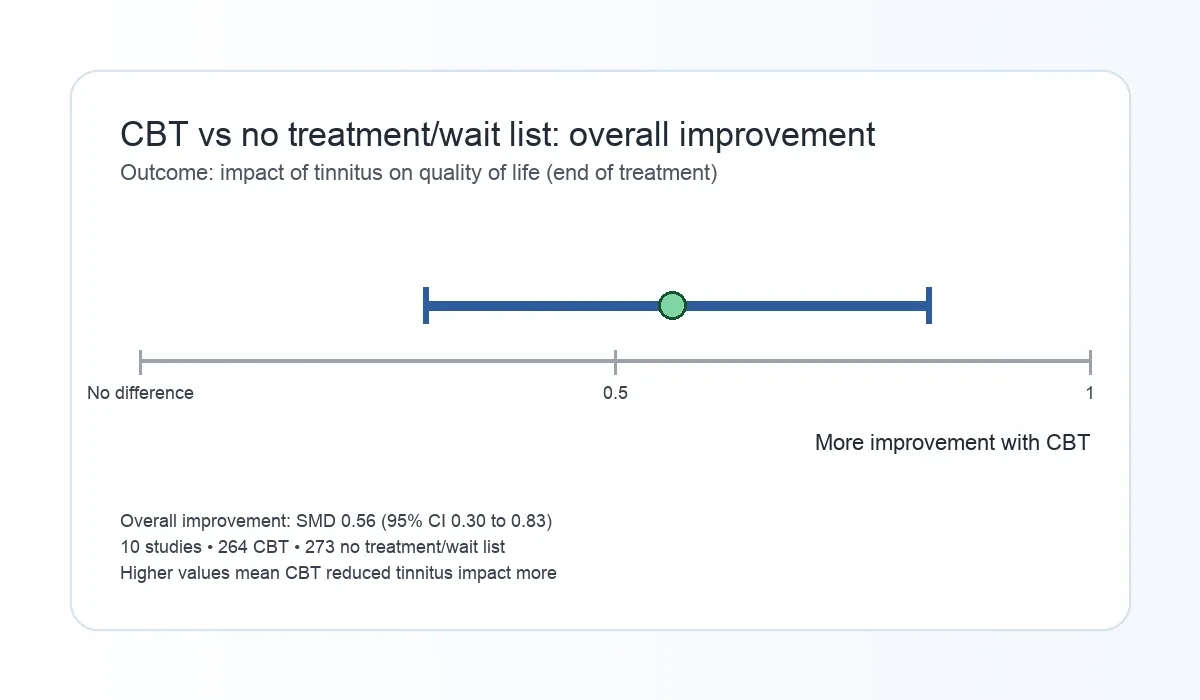
CBT can help reduce the distress tinnitus causes, even when the sound remains. The 2020 Cochrane review included 28 trials. Its current abstract reports 2,733 participants and low- to moderate-certainty evidence for improvement in tinnitus-related quality of life at the end of treatment. That supports trying CBT for coping skills; it does not establish a cure or guarantee an individual result.
As a clinician, I distinguish the burden of tinnitus from the sound itself. The useful question is whether treatment makes daily life more manageable. Long-term effects and outcomes such as anxiety are less certain in this review.
Updated September 12, 2026: The participant count now follows Cochrane’s current abstract (2,733), replacing the 3,385 figure previously used here. The 28 trials evaluate CBT approaches, not Reductinn. Reductinn has not published a trial of its own app.
What the Cochrane review found
Fuller and colleagues searched through November 2019. CBT generally performed better on tinnitus-related quality of life than waiting-list or other comparison care at treatment end. The review had insufficient evidence for its six- and twelve-month follow-up comparisons. Adverse effects were uncommon where reported, but some participants deteriorated; “no harm” would overstate the findings.
For practical next steps, read whether CBT fits your tinnitus goals, our nighttime tinnitus guide, or the tinnitus app comparison.
The large real-world trial: Cima et al. (The Lancet, 2012)
If the Cochrane review is the big-picture answer, Cima et al. in The Lancet is the trial I would hand to anyone who thinks CBT is "just talking."
This randomized trial followed 492 adults assigned either to specialized CBT-based tinnitus care or to usual care. The CBT-based program improved quality of life and reduced tinnitus severity more than usual care over 12 months.
Why that study matters:
- It was large.
- It used real clinical care, not an artificial lab setup.
- It followed people long enough to show the benefit was not just a short-lived placebo bump.
Earlier meta-analysis: Hesser et al. (2011)
Before the Cochrane review, Hesser et al. had already shown that CBT produced a meaningful effect on tinnitus distress across randomized trials.
That paper is still important because it established the pattern we continue to see:
- CBT has a moderate effect on distress.
- The benefit is bigger for how people react to tinnitus than for the raw loudness of the sound.
- The treatment target is the distress loop, not the ear itself.
Format matters less than structure: Landry et al. (2020)
One of the most useful later papers is Landry et al.'s network meta-analysis.
Their practical message was simple: CBT works in more than one format. Individual CBT, group CBT, and internet-delivered CBT all outperformed passive controls. No single format clearly dominated every other format.
That matters for patients because it means access is more flexible than people assume. You do not always need a weekly in-person specialist appointment to get evidence-based tinnitus care.
Digital CBT is real care, not a watered-down backup
That access question is where the newer literature gets especially useful.
Beukes et al. (2022) showed that guided internet-based CBT improved tinnitus outcomes compared with a control condition. The point was not that digital care is magical. The point was that structured CBT skills can still work when delivered remotely.
That story kept improving in 2025. In Walter et al.'s randomized smartphone trial, participants using an app-based tinnitus program showed significant reductions in tinnitus burden compared with a wait-list control.
For most patients, this is the most important "new" development in the literature: not a miracle device, but better ways to deliver the treatments we already know can help.
What CBT seems to change
The modern neuroscience literature helps explain why CBT can work even when the sound remains.
Tinnitus distress is not just an ear problem. Reviews and imaging work describe a network that includes:
- auditory processing
- attention and salience systems
- emotion-related circuits
- habitual monitoring and rumination
That is why CBT focuses on:
- catastrophic thoughts
- constant checking and monitoring
- avoidance of quiet places or valued activities
- sleep-related fear
- the belief that every spike means damage or danger
When those patterns loosen, the tinnitus often feels less central, less urgent, and less dominating.
What the evidence does not support
This is the part many websites skip.
The literature does not support:
- guaranteed silence
- one universal "success rate" for everyone
- the claim that CBT works by fixing cochlear damage
- the idea that one format of CBT is clearly best for every patient
What the evidence does support is more modest and more believable: many people become less bothered, sleep better, cope better, and regain function.
What "success" usually means in these studies
If you read the primary papers, success usually looks like:
- lower tinnitus handicap or distress scores
- better quality of life
- less anxiety around the sound
- better sleep
- less time spent monitoring tinnitus
That may sound less dramatic than "cure," but clinically it is the difference between being controlled by tinnitus and living normally with it in the background.
Bottom line
After source-checking the major papers, my conclusion is straightforward:
- CBT is the best-supported treatment for tinnitus distress.
- The strongest evidence comes from randomized trials and systematic reviews, not testimonials.
- Digital delivery is now credible enough to take seriously.
- The benefit is about reducing burden and restoring function, not promising silence.
If you want the shortest honest version, it is this: CBT will not be the right tool because it is dramatic. It will be the right tool because the literature keeps supporting it.
References
- Fuller T, Cima R, Langguth B, Mazurek B, Vlaeyen JWS, Hoare DJ. Cognitive behavioural therapy for tinnitus. Cochrane Database of Systematic Reviews. 2020.
- Cima RFF, Maes IH, Joore MA, et al. Specialised treatment based on cognitive behaviour therapy versus usual care for tinnitus: a randomised controlled trial. The Lancet. 2012.
- Hesser H, Weise C, Westin VZ, Andersson G. A systematic review and meta-analysis of randomized controlled trials of cognitive-behavioral therapy for tinnitus distress. Clinical Psychology Review. 2011.
- Landry EC, Sandoval XCR, Simeone CN, et al. Systematic Review and Network Meta-analysis of Cognitive and/or Behavioral Therapies (CBT) for Tinnitus. Otology & Neurotology. 2020.
- Beukes EW, Andersson G, Fagelson M, Manchaiah V. Internet-Based Audiologist-Guided Cognitive Behavioral Therapy for Tinnitus: Randomized Controlled Trial. Journal of Medical Internet Research. 2022.
- Walter U, Pennig S, Bleckmann L, et al. Continuous Improvement of Chronic Tinnitus Through a 9-Month Smartphone-Based Cognitive Behavioral Therapy: Randomized Controlled Trial. Journal of Medical Internet Research. 2025.
Want the practical version? Reductinn packages the same CBT principles the literature keeps supporting into a structured mobile program.
Ready to take control?
Reductinn teaches these evidence-based techniques and more through a structured program designed by medical experts.