Best tinnitus apps for relief in 2026.
Choose a tinnitus app by what you need: a structured CBT course, free sound tools, or support through a provider. Compare five options below, including price, access and the difference between evidence for CBT and trials of a particular app.
Disclosure
This comparison is published by Dirkes Medical, PLLC, the maker of Reductinn. Reductinn is one of the apps ranked here, and we score it against the same public-source criteria as every other app. We include our own product openly rather than leaving it out of the comparison.
| App / use case | Price and free access | Platform / access |
|---|---|---|
| Reductinn: structured CBT | $19.99 USD once; first 3 days free | iPhone and Android |
| ReSound: free sound tools | Free basic toolkit; optional $6.99/month or $69.99/year | iPhone verified; check local Android availability |
| Kalmeda: German CBT program | €189 for 90 days in its shop; prescription access differs | iPhone and Android; German market |
| Oto: provider-supported US access | US price through a participating provider | US direct subscription unavailable; ask provider about device support |
| MindEar: sound and coping tools | US listing includes $5.99/month and $58.99/year; other tiers exist | iPhone and Android linked by the developer |
Prices and access checked September 12, 2026. Offers vary by country and account; confirm the price in the app before purchasing. Sources are linked in each app review below.
These are our editorial scores, not independent ratings or a clinical ranking. Reductinn has no published trial of the app itself.
Before choosing, read whether CBT fits your tinnitus goals or why tinnitus feels worse at night.
Reductinn
CBT-first self-management
98
out of 100
$19.99
One-time unlock in USD after 3 free days
Kalmeda
Prescription-style CBT app
85
out of 100
189 EUR / 90 days
Current Kalmeda Go shop price
Oto
Clinician-linked audio program
76
out of 100
No US pricing
US access is arranged through a participating provider
MindEar
Hybrid soundscape plus expert support
70
out of 100
$58.99 / year
Current US App Store annual plan
ReSound Relief
Sound-first tinnitus toolbox
58
out of 100
$69.99 / year
Current App Store annual plan
App breakdowns
How each app compares
These are short review summaries, not full hands-on reviews. Each card links the public sources used, shows the overall weighted score, and highlights the main reasons an app scored where it did.

Reductinn
CBT-first self-managementStructured CBT-based tinnitus self-management with night support and source-checked evidence pages.
Overall score
Ranked #1 overall
Reductinn scored highest in this scorecard because it combines a clearly structured CBT course, unusually transparent evidence pages, and the lowest straightforward paid entry point in this group. Its pricing also stands out because the current paid offer is a low one-time unlock rather than a recurring plan or a 90-day purchase window.
Use case
People who want the clearest evidence-first self-guided program they can start today on iPhone or Android.
Public pricing
One-time unlock in USD after 3 free days
Direct download on iPhone and Android. The first 3 days of content are free, and the full course unlock costs $19.99 USD as a one-time purchase. Regional prices may vary.
Highest-scoring areas
Lower-scoring areas
Main tradeoff
The app has limited sound options and no daily reminders.
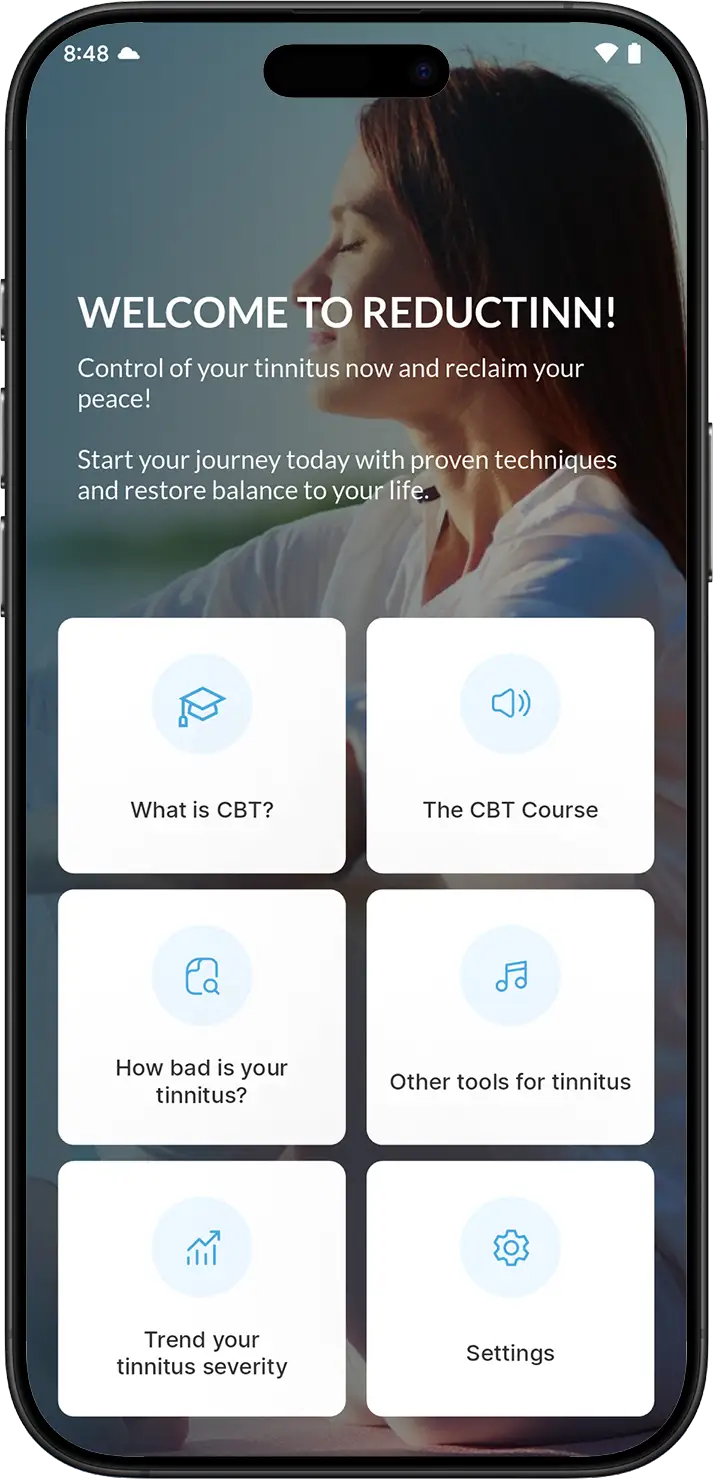
Reductinn in-app home screen reviewed on March 17, 2026.
Science note
Built around CBT-based education and exercises, which is the strongest evidence-supported feature family in this comparison.
Access note
Built for direct-to-consumer use in the US without a clinic gate, recurring subscription, or triple-digit upfront commitment.
Evidence note
Reductinn publishes a public research hub, a press page, and a dedicated CBT evidence page that make its claims easy to audit.
ReSound Relief
Sound-first tinnitus toolboxA long-running sound therapy and relaxation app with customizable soundscapes and basic planning tools.
Strongest option here if sound masking and quick audio relief are the main priority.
Overall score
Ranked #5 overall
ReSound Relief is not trying to be a CBT course. It is a long-running sound-therapy app, and that narrower focus is exactly why it stands out here for masking, layering soundscapes, and immediate audio relief. It ranks lower overall because the public evidence and program structure are lighter than the CBT-first apps.
Use case
People whose main need is immediate sound support, masking, and a free basic toolkit rather than a guided CBT course.
Public pricing
Current App Store annual plan
The US App Store describes a free basic toolkit, with optional My Plan at $69.99/year or $6.99/month (checked September 12, 2026).
Highest-scoring areas
Lower-scoring areas
Main tradeoff
This is a sound and relaxation toolkit, not a structured CBT course. Android availability needs checking in your local store: ReSound’s regional pages and support pages give conflicting availability information.
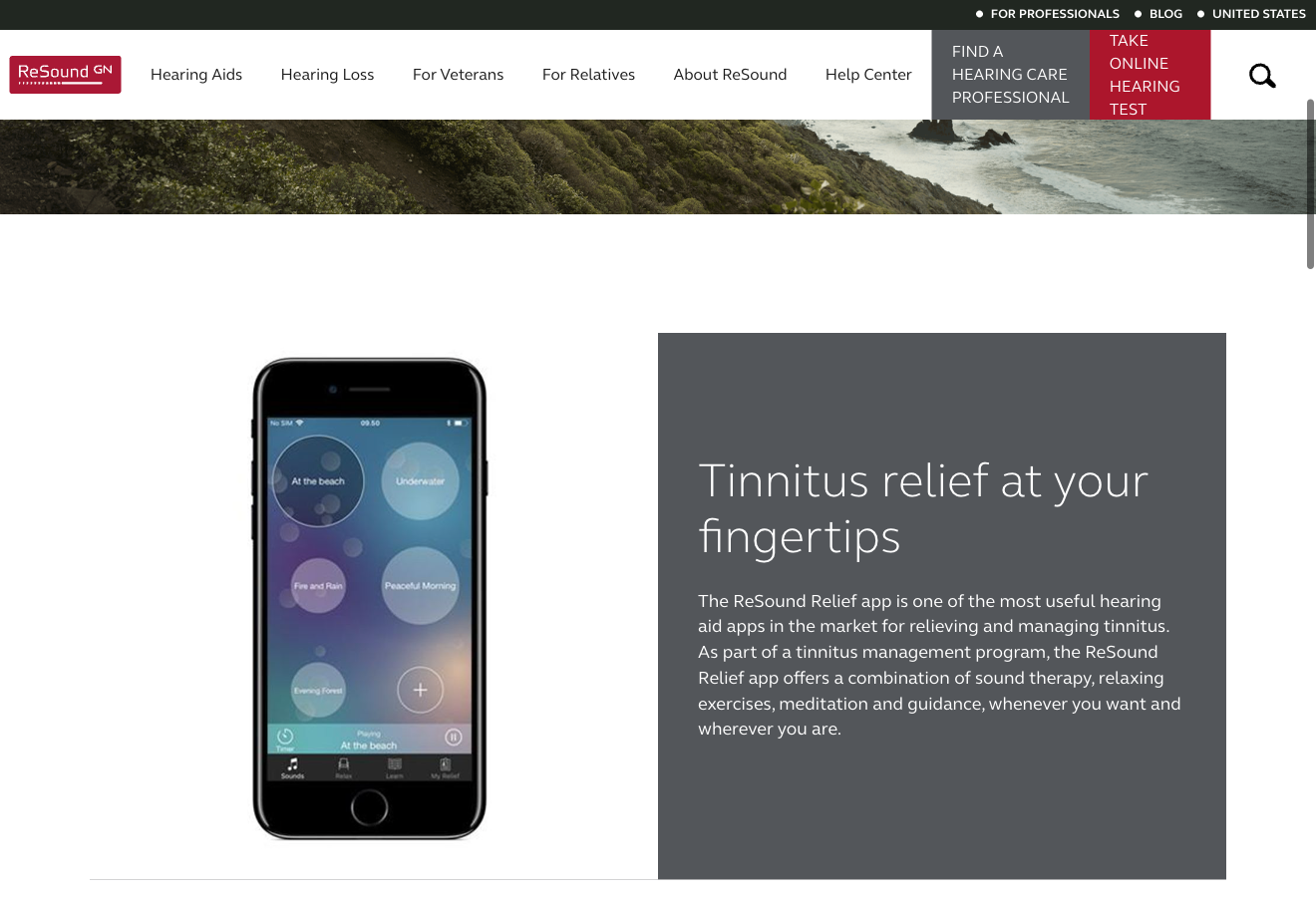
ReSound Relief public product page reviewed on March 17, 2026.
Science note
ReSound's core method is sound therapy plus relaxation, which is legitimate as a coping layer but does not help tinnitus as much as CBT-first approaches.
Access note
Free basic toolkit on iPhone; optional personalized plans use recurring billing. Confirm Android availability in your region before choosing it.
Evidence note
Public pages do a good job explaining features, but the evidence story is lighter and less source-forward than the highest-scoring apps.
Kalmeda
Prescription-style CBT appA German DiGA-focused tinnitus app built around a formal CBT program with defined levels, stages, and reimbursement pathways.
Overall score
Ranked #2 overall
Kalmeda has one of the clearest therapeutic structures in the set, with a formal CBT-style progression and strong medical framing. It scores well on science and structure, but its access story is much less straightforward for a typical user because the strongest path is still tied to Germany's DiGA or insurer route.
Use case
German users who want a prescription or insurer-backed CBT path and are comfortable with a more medical framing.
Public pricing
Current Kalmeda Go shop price
The official Kalmeda shop lists Kalmeda Go at 189.00 EUR for 90 days.
Highest-scoring areas
Lower-scoring areas
Main tradeoff
Access is much less straightforward for a typical US user, and the public self-pay entry point is a high triple-digit 90-day price.
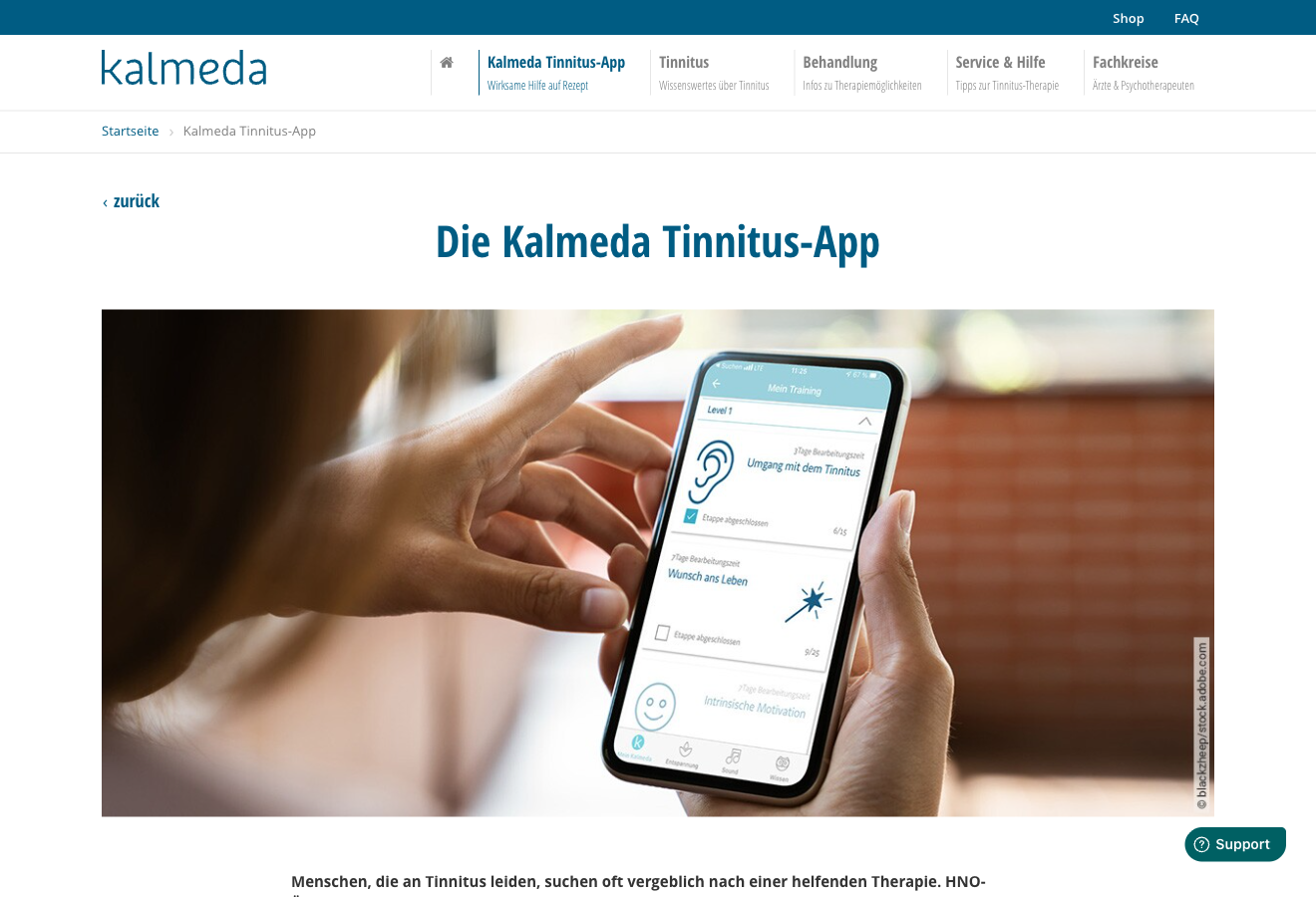
Kalmeda public product page reviewed on March 17, 2026.
Science note
Kalmeda is a CBT-based therapy with strong published product-specific evidence: one randomized trial of the Kalmeda app, with peer-reviewed 3-month results in PLOS Digital Health (2023) and a separately published 9-month follow-up in JMIR (2025). The trial reported a large effect at 3 months and improvement sustained at 9 months. It was company-sponsored and included product-affiliated authors.
Access note
Most practical for Germany-based users who can use the DiGA or insurer route. Much weaker immediate access for general US users.
Evidence note
Kalmeda's product-specific randomized trial and its 9-month follow-up are peer-reviewed and straightforward to verify, though its wider public source layer is less reader-friendly for English-speaking comparison shoppers.
Oto
Clinician-linked audio programAn audiologist-led tinnitus program that combines daily app sessions, behavior-change skills, and ongoing clinical care.
Overall score
Ranked #3 overall
Oto presents itself as an audiologist-led tinnitus program with daily app sessions, behavior-change framing, and a strong emphasis on sleep-facing support. US residents cannot buy an Oto subscription directly and must receive access through a participating healthcare provider.
Use case
US users who want an audiologist-guided program and are comfortable arranging access through a participating clinic.
Public pricing
US access is arranged through a participating provider
Oto's terms say its subscription is not available to US residents. US users receive access through participating healthcare providers, so there is no standardized public US consumer price.
Highest-scoring areas
Lower-scoring areas
Main tradeoff
Oto is not available as a direct-to-consumer subscription in the US; access and pricing must be arranged through a participating healthcare provider.
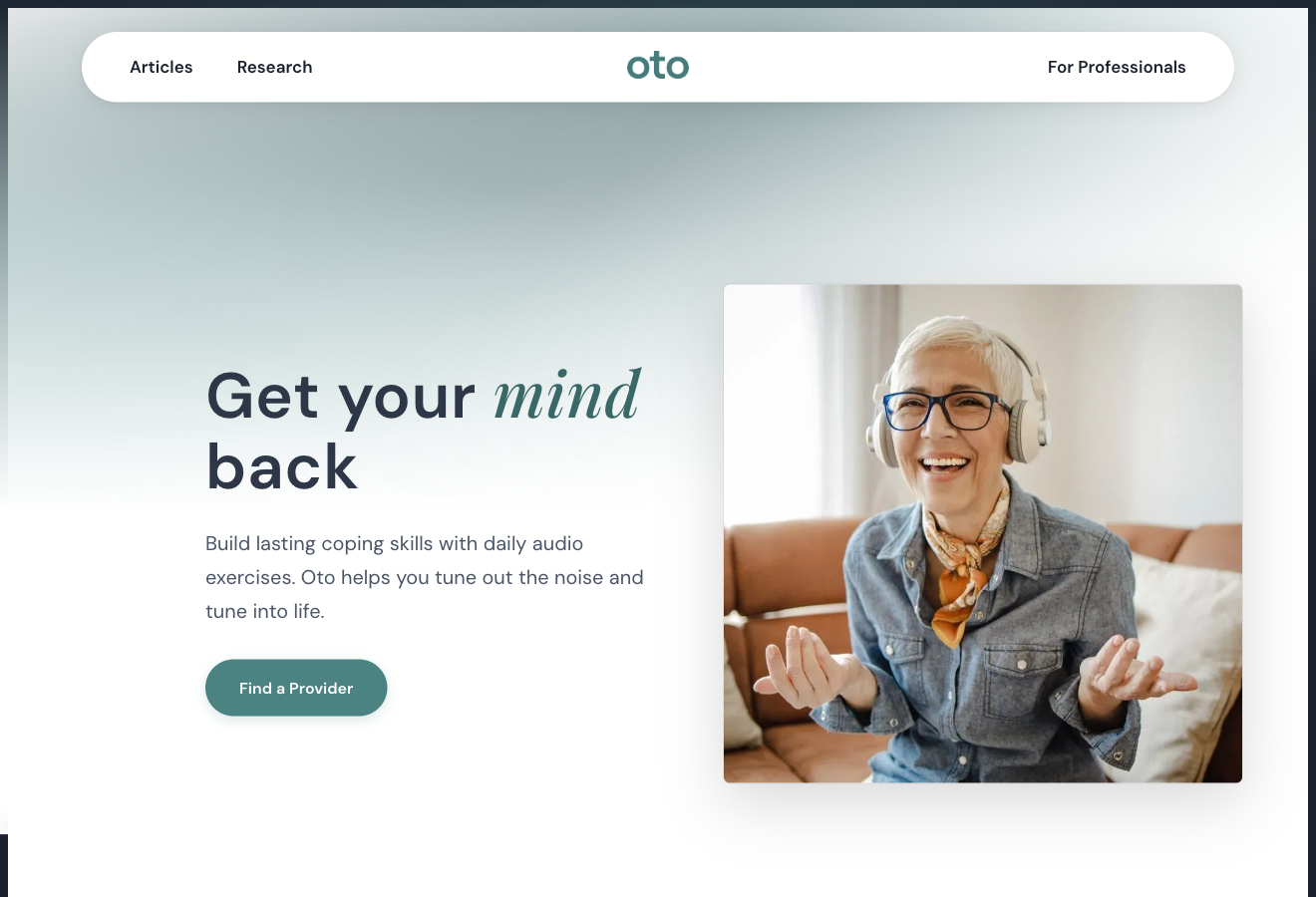
Oto public product page; US access model rechecked on July 16, 2026.
Science note
Oto ties its product to CBT-based behavior change and has completed registered randomized trials of the app itself, including a published wait-list-controlled RCT and a large non-inferiority trial against one-to-one CBT (headline results pending peer review). As with the other product trials here, these are company-sponsored, but they remain strong, verifiable scientific positioning for Oto.
Access note
In the US, start with Oto's provider directory or a participating audiologist. The app may be listed in app stores, but the Oto subscription itself is not sold direct to US consumers.
Evidence note
Oto publishes a research page listing registered and peer-reviewed randomized trials of its own product, which a skeptic can verify directly.
MindEar
Hybrid soundscape plus expert supportA customizable tinnitus app that mixes soundscapes, chat, education, and optional expert appointments.
Overall score
Ranked #4 overall
MindEar offers the broadest mix of soundscapes, education, chat, and optional expert support in this comparison. That flexibility makes it interesting for users who want a modular toolkit, but it also means a less structured therapeutic approach.
Use case
People who want flexible sound tools first and like the option of adding remote expert support later.
Public pricing
Current US App Store annual plan
The current US App Store listing shows multiple paid tiers, including MindEar Annual at $58.99, a $5.99 monthly plan, and higher-priced premium options.
Highest-scoring areas
Lower-scoring areas
Main tradeoff
The core product story is broader and less tightly structured than a CBT-first course, so the therapeutic arc is harder to verify from public pages.
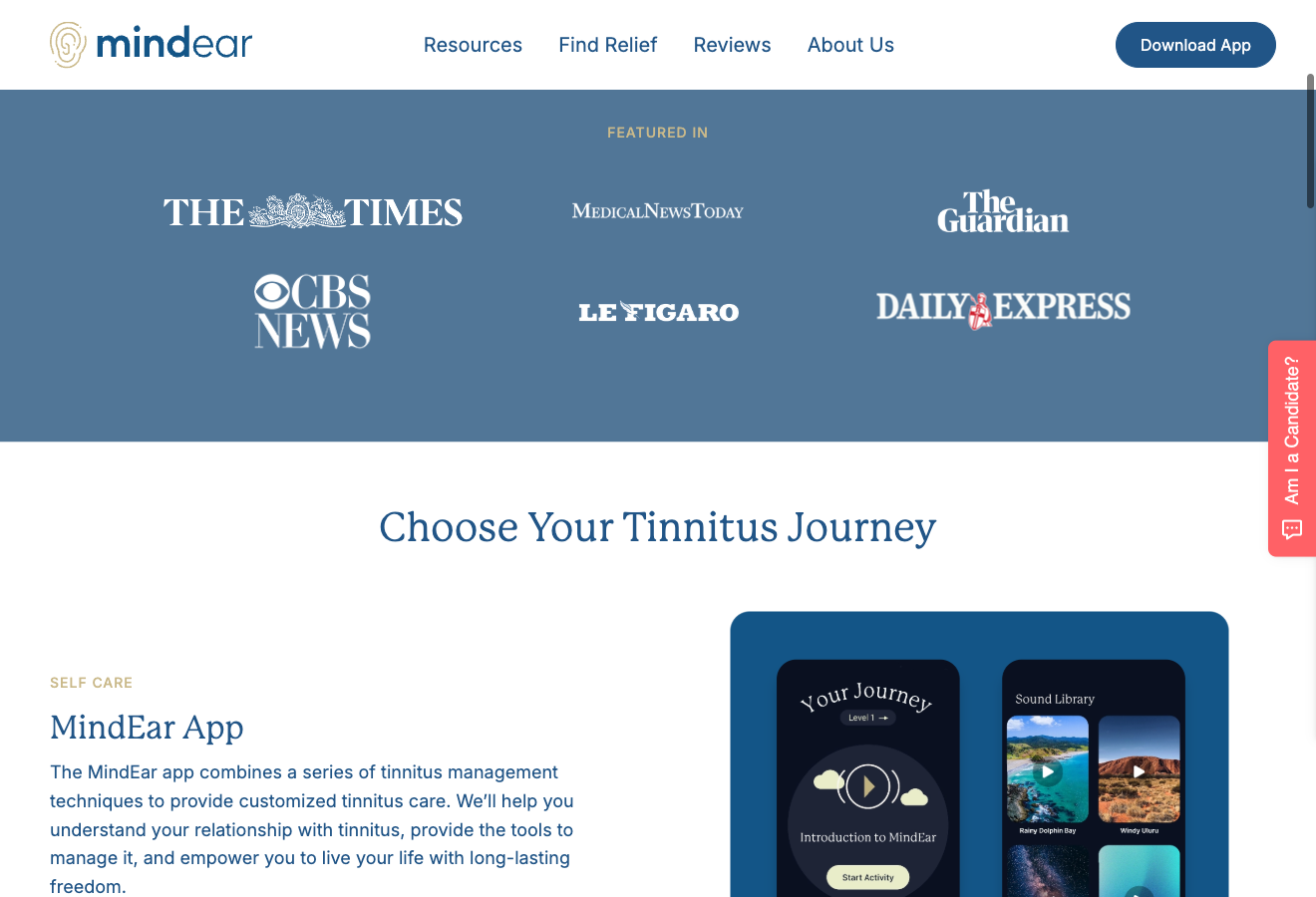
MindEar public product page reviewed on March 17, 2026.
Science note
MindEar combines CBT, mindfulness, sound therapy, and AI-powered personalization. Its chatbot lineage has randomized-trial support: company-sponsored RCTs of the predecessor app, Tinnibot (Bardy et al. 2024; Jackson et al. 2026, 105 participants, waitlist-controlled), reported reduced tinnitus distress, anxiety, and depression. Those trials evaluated the earlier Tinnibot version rather than the current MindEar build.
Access note
Easy to start, especially for users who prefer trying an app before talking to a clinician, but the pricing model is recurring rather than a low one-time unlock.
Evidence note
MindEar's chatbot has published randomized trials to cite, but its consumer pages are more marketing-led than citation-led, so the therapeutic evidence is harder to verify at a glance.
Price comparison
What the pricing actually looks like
If you are choosing between these apps, the pricing model matters almost as much as the feature list. This is the practical version of what a typical user can expect.
| App | Public price reviewed | Billing model | Reviewer take |
|---|---|---|---|
Reductinn CBT-first self-management | $19.99 One-time unlock in USD after 3 free days | One-time unlock | The simplest paid offer in this set: a low one-time unlock after the free intro, with no subscription to keep justifying. |
MindEar Hybrid soundscape plus expert support | $58.99 / year Current US App Store annual plan | Monthly or annual subscription | Relatively approachable to start, but it is still a subscription product, so the value depends on whether you plan to keep using it. |
ReSound Relief Sound-first tinnitus toolbox | $69.99 / year Current App Store annual plan | Monthly or annual subscription | Reasonable if your main need is sound masking, but premium access still pushes you into recurring billing. |
Oto Clinician-linked audio program | No US pricing US access is arranged through a participating provider | Access through a participating provider | Oto does not sell a consumer subscription to US residents. Access and pricing are arranged through a participating audiologist or hearing clinic. |
Kalmeda Prescription-style CBT app | 189 EUR / 90 days Current Kalmeda Go shop price | 90-day purchase | Clear structure, but the public self-pay route is the biggest upfront commitment in the group. |
Why Reductinn's pricing stands out
From a reviewer's standpoint, Reductinn is the easiest paid option here to recommend on price alone. It asks for a small one-time unlock instead of a subscription or a short-term 90-day purchase, which lowers the risk of trying it and makes it easier to come back later without another buying decision.
How we reviewed
What this scorecard rewards
We reviewed public product pages, public help pages, App Store listings, and linked research or evidence pages available on September 12, 2026. If a claim could not be verified from public materials, it did not help the score. The weights below reflect this page's focus: evidence-first, self-guided tinnitus relief.
Scientific basis
25% of total
How well the app's core method lines up with the strongest tinnitus evidence. Structured CBT gets the highest marks because it has the best randomized-trial support for reducing tinnitus distress. This factor scores how closely a method aligns with that evidence base, not whether the individual app has been tested in its own clinical trial.
Evidence transparency
15% of total
How easy it is for a skeptic to verify the product's claims on public pages before downloading.
Program structure
15% of total
Whether the app feels like a guided program with progression, milestones, and a clear therapeutic arc instead of an unstructured tool bucket.
Sleep and night support
10% of total
How directly the app addresses nighttime distress, bedtime routines, and sleep disruption, which is a major tinnitus pain point.
Sound support
10% of total
How strong the app's sound masking, soundscape, or sound-enrichment toolkit is when users need immediate relief in difficult moments.
Progress tracking
10% of total
How clearly the app surfaces progress, goal completion, questionnaires, or usage patterns so users can see movement over time.
Price and access
15% of total
How affordable and easy it is to start today without clinic gatekeeping, insurer paperwork, or unclear pricing.
FAQ
Common comparison questions
Which tinnitus app has the strongest scientific basis?
Several apps here have their own trials showing efficacy for tinnitus relief. Kalmeda has strong published product evidence from one peer-reviewed RCT, with separate publications reporting the 3-month comparison and 9-month follow-up; Oto has a published wait-list RCT plus a Cambridge-led non-inferiority trial vs one-to-one CBT, with results pending peer review. MindEar has randomized-trial evidence from its predecessor app, Tinnibot, and ReSound has clinical study data. Reductinn faithfully delivers the CBT method with the best overall evidence for tinnitus distress but hasn't yet published a trial of the Reductinn app itself — so on product-specific trials, Kalmeda and Oto lead. Most of these product trials are company-sponsored and include product-affiliated authors, which is common in this field and worth keeping in mind.
Is CBT better supported than sound therapy for tinnitus?
For tinnitus distress, yes. Sound therapy can be useful, especially for immediate relief or sleep, but the strongest evidence still favors CBT-based approaches for long-term coping and burden reduction.
Why does cost and access matter in this ranking?
Because the best app on paper is not helpful if a user cannot realistically start. We score whether someone can download the app, understand the pricing model, and begin without clinic or insurer friction.
Which tinnitus app is the cheapest to start?
ReSound offers a free basic sound toolkit. For a paid CBT course, Reductinn’s current one-time unlock is $19.99 USD (pricing updated September 12, 2026). Monthly plans can cost less initially but recur. Kalmeda's shop listed 189.00 EUR for 90 days, while MindEar and ReSound used recurring or annual pricing. Oto's US access model was rechecked on September 12, 2026: it does not offer a direct-to-consumer subscription to US residents, so access and pricing must be arranged through a participating healthcare provider.